
Short answer: a rotary premade pouch machine clamps a pouch once and indexes it through a ring of work positions. The station count says how many positions the pouch passes through — not which operations sit at them. That second part decides seal quality, which pouch formats the machine can run, and how much work a bag change is. Six can hold a dedicated opening position and a controlled seal; eight can spend the extras on settling, zipper work or a second seal. You choose from the layout, not the number.
What the station count actually changes
The pouch is clamped at pick-up, travels through every position in sequence, and is released at discharge. Adding one position means another cam segment or servo axis, another set of jaws or vacuum block, more pneumatics, PLC timing and usually a larger table — so station count is a real cost driver.
One caution. Builders do not count stations to one standard: some count pick-up, some coding, some discharge; some treat a combined seal-and-cool block as one position, others as two. Two machines sold as “six-station” may not be the same hardware — some six-position machines keep a dedicated opening position, some merge opening and filling, some combine sealing and cooling. Only the layout drawing shows what you are quoted.
The operations a rotary machine can perform
| Operation | What it does | If it shares a position |
|---|---|---|
| Pouch pick-up | Magazine to clamp | Manual infeed |
| Coding | Date, lot or batch code | Moves downstream, onto a curved surface |
| Opening | Vacuum cups plus air jet | Shorter open window |
| Filling | Product through a funnel from the doser | Fill and open tightly synchronised |
| Settling | Vibration, tapping or a dwell | Product sits high; dust near the seal |
| Secondary processing | Zipper work, nitrogen flush, second fill | Added elsewhere or dropped |
| Sealing | Heat or ultrasonic across the mouth | Single-pass sealing only |
| Cooling | Held under pressure while the seal sets | Seal still soft at release |
| Discharge | Onto a conveyor | Manual removal |
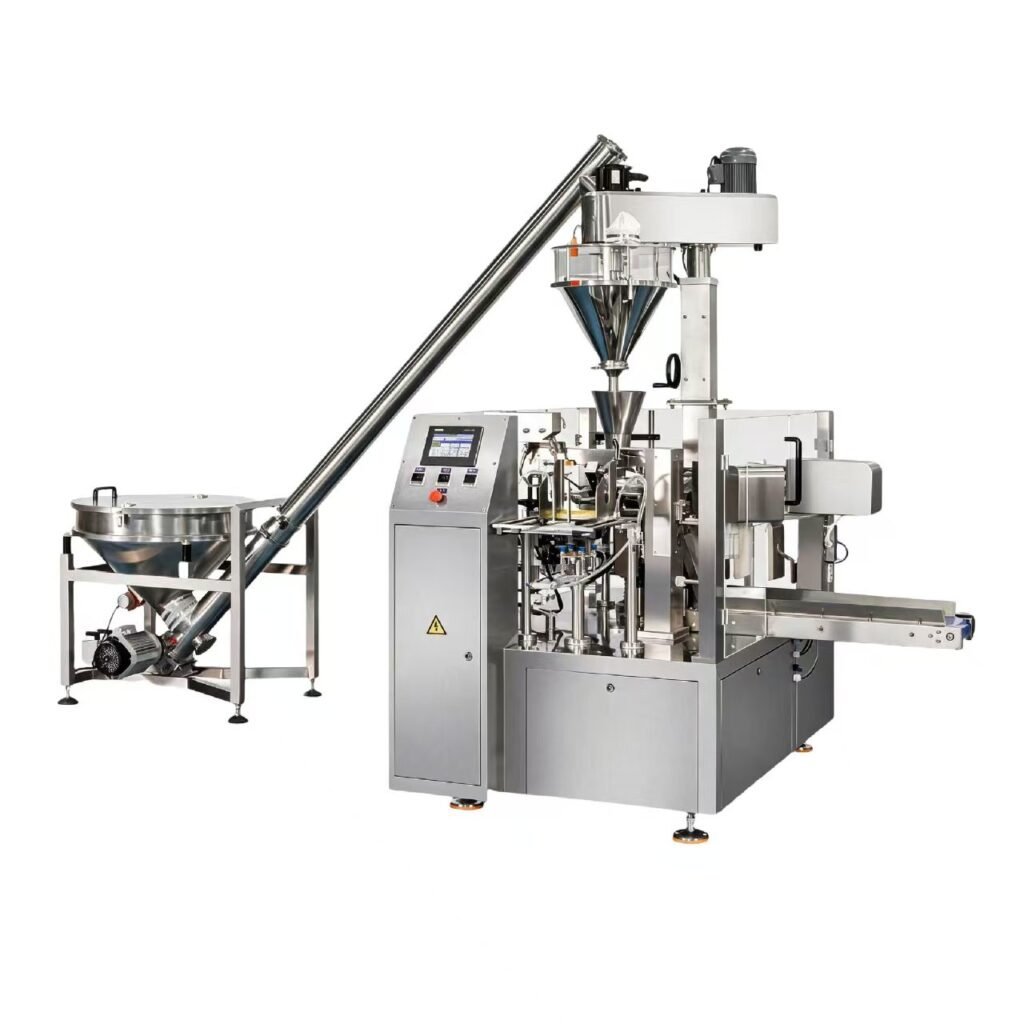
A station count and an operation list are different things. Our specification page describes the platform as an eight-station machine and lists nine operations on it: pick-up, coding, opening, filling, settling, secondary processing, sealing, cooling and discharge. That is not a contradiction — the list describes operations, not positions. Two operations can share one position, and the grouping differs from model to model. The position-by-position assignment is shown on the general arrangement drawing of the model you are quoted.
What the published specification covers
| Model | Pouch width | Pouch length | Filling range | Published speed |
|---|---|---|---|---|
| SPM-200R | 80–200 mm | 100–320 mm | 10–1500 g | 10–60 bags/min |
| SPM-250R | 120–250 mm | 100–360 mm | 10–2500 g | 10–60 bags/min |
| SPM-320R | 180–320 mm | 100–420 mm | 100–5000 g | 10–50 bags/min |
Shared by all three: 8-station platform, fill accuracy ±1% paired with a filler suited to the product, 4.5–7.5 kW, 380 V / 50 Hz (other voltages to order), 0.6 MPa compressed air.
Read the speed column as a published range, not a tested production rate: whether 10–60 bags/min is a sustainable running speed or a mechanical index rate is not stated. Confirm it by running your product and pouch. The ±1% figure is published as “paired with a filler suited to your product”; line accuracy depends on the dosing system fitted and is verified in a sample test.
The platform description is the same for all three models and lists settling, secondary processing and cooling among its functions. Whether each of those is standard or an option on a specific quotation should be confirmed with the supplier before you sign.
When six positions can be the right choice
- Product: free-flowing granules or small solid pieces, little dust, no oil film on the pouch wall.
- Pouch: three-side seal or a plain stand-up with a simple top seal.
- Speed: a moderate target with headroom.
- Layout: a real opening position and a controlled seal.
When eight positions is the better decision
- Powder and fine chemicals. Dust at the pouch mouth is the main enemy of a clean seal. Settling, dust extraction at the filling and sealing zone, a second seal or controlled cooling all address it — which you need depends on the product and film.
- Pouch formats that need extra functions in the cycle. Zipper, spout and flat-bottom pouches are not tied to a station count. What decides is the pouch structure, how it is opened, the product, the sealing requirement and the machine configuration. A zipper needs an opening and closing function in the cycle and a spout needs clearance, but each can have a dedicated position or share one. Ask how the machine handles your pouch, not its station count.
- Buyers who audit the process. A separate seal plus cooling is easier to witness in a factory acceptance test than one combined block.
Where the real speed limit sits
The pouch-per-minute figure in the brochure is usually limited by the dosing system, not the rotary table.
| Dosing system | Typical fit | Effect on line speed |
|---|---|---|
| Volumetric cup | Free-flowing granules, stable density | Fast; accuracy drifts when the product changes |
| Auger filler | Powders, flour, ground coffee | Slower per dose; screw size and drive decide |
| Multihead weigher | Snacks, nuts, irregular pieces | Fastest for piece goods; needs a stable feed |
A table can index faster than an auger can dose — which is why the question is “how fast with my product, in my pouch”.
Three problems the configuration decides
1. “We lose time every time we change bag size.” The pouch is clamped, not formed from film, so a bag change is a mechanical adjustment — forming set, clamp width, sealing jaws — not a film-threading job. The real cost is how many adjustments it needs and whether a second forming set is included.
2. “Our powder bags leak after the container, not in the factory.” That is a seal-zone problem with more than one cause: dust in the seal area when the jaws close; insufficient cleaning of the pouch mouth; temperature, pressure and dwell time that do not match the film; a sealing layer unsuited to the product; residue on the jaws; jaw alignment. Settling, dust extraction or a second seal can each help, but none guarantees a leak-free pouch on its own — verify on a sample test, do not tick it as a feature.
3. “We cannot find operators.” Automatic pick-up removes the manual bag-feeding step: the operator loads product and removes finished pouches instead of placing every bag by hand. That reduces the labour attached to one pair of hands, but it does not remove the operator, or the need for someone who can change bags and clear faults.
The gains are not one number: fewer rejects, faster changeover, less give-away, less restarting — each verifiable before shipment with your own product and pouch, by the methods above.
The five specs that decide the price
- Dosing system — volumetric cup, auger, multihead weigher (and how many heads).
- Drive and control — servo or stepper, and how many axes are servo. The difference depends on motors, drivers, controller and axis count, so it cannot be a fixed percentage.
- Frame and product-contact material — painted carbon steel or 304 stainless, and which parts are stainless.
- Station layout and seal type — how positions are arranged, heat or ultrasonic, whether cooling under pressure is included.
- Tooling — how many forming sets are included, and the price of an extra set later.
Ask for these as separate line items: a quote that gives only a total cannot be compared.
A short RFQ checklist
- Product, bulk density, and whether it is dusty, oily, sticky or fragile
- Pouch type, width × length in mm, fill weight in grams
- Target pouches per minute, and at which fill weight
- Pouch material structure (for example PET/AL/PE or PET/PE)
- Local voltage and frequency at the site
- Whether CE documentation is required, and for which country
- Documentation needed: English manual, wiring diagram, test report, spare parts list
Suppliers who answer all seven are quoting your machine. Suppliers who answer three are quoting theirs.
FAQ
Is an 8-station machine always faster than a 6-station machine?
No. Speed is set mainly by the dosing system and pouch size. Extra positions buy seal quality and format capability more often than throughput.
Can a 6-station machine be upgraded to 8 stations later?
Rarely as a field change, and it has to be checked with the builder: it depends on the frame, cam or servo arrangement, control system and space. Treat the count as a purchase-time decision.
Do I need eight stations for zipper or stand-up pouches?
Not automatically. It depends on the pouch structure, how it is opened, the product, the sealing requirement and the machine configuration. A zipper pouch needs an opening and closing function in the cycle and a spout needs clearance, but neither has to occupy a dedicated position. Plain stand-up pouches with dry granules can run well on six.
What is the difference between heat sealing and ultrasonic sealing here?
Heat sealing covers most laminated films and is the usual choice. Ultrasonic sealing uses high-frequency vibration to generate heat at the seal interface; it can be considered for certain film structures and powder applications, but suitability depends on the film, the sealing area and the product, and must be verified by testing your own material. Specify it at order time.
Why do rotary pouch machine prices vary between suppliers?
Because the quotes are rarely for the same machine. What moves the price: station number and arrangement; the dosing system and its capacity; drive type and servo axis count; frame and contact-part material; seal type and whether cooling is included; how many forming sets come with the tooling; documentation scope; and scope of supply — bare machine, or a line with elevator, conveyor, metal detector and checkweigher. Two far-apart quotes are usually two different scopes; ask for a line-item breakdown.
Next step: three lines are enough to get a real answer
- Product — what it is, and whether it is powder, granules or pieces
- Pouch — style, width × length in mm, fill weight in grams
- Site — country, voltage and frequency, and whether CE documents are needed
With those three lines we can tell you which model fits and which options you can skip. If your product is awkward — dusty, oily, sticky or very light — say so in line one.
Send your three lines here and you will get a configuration recommendation before you get a price. Or compare the full rotary premade pouch range against a VFFS line and read which pouch styles each machine handles before you commit to a pouch format.